
The KDF® Legacy: Durable Water Treatment Media for Long-Term Performance
Protection You Can Pass Down Protection isn’t just about solving today’s problem. It’s about safeguarding what comes next.
2 min read
True protection in water treatment is defined by long-term performance over the full lifecycle of the system.
In water treatment, performance is often judged at the starting line. Flow rates, reduction claims, and laboratory test results tend to dominate product comparisons. But real-world systems don’t operate in controlled conditions — and performance doesn’t stop being evaluated after installation.
True protection isn’t a moment. It’s performance over time.
As the industry continues to prioritize system reliability, maintenance reduction, and total cost of ownership, it’s becoming clear that initial performance specifications only tell part of the story. To truly understand value, water treatment media must be evaluated across its full lifecycle.
Laboratory data and startup performance are essential — but they represent only a snapshot in time. Many media types can meet performance benchmarks on day one, yet struggle to maintain that effectiveness as conditions change.
Over time, water chemistry fluctuations, oxidant exposure, fouling, and mechanical wear can all degrade performance. When that happens, systems may experience declining efficiency, increased maintenance, or premature media replacement — even though the original specifications looked solid on paper.
Performance that fades isn’t protection. It’s a liability.
Most conventional media degrade through predictable mechanisms:
The challenge isn’t just degradation itself — it’s inconsistency. Media that degrade unevenly can introduce variability into system performance, making it harder to predict service life or plan maintenance.
By contrast, media engineered for durability and stability are designed to resist these degradation pathways. When performance mechanisms remain intact over time, effectiveness doesn’t depend on frequent replacement or intervention.
Lifecycle value goes beyond how well a media performs at installation. It reflects how that performance holds up under continuous operation — and how it impacts the system as a whole.
True lifecycle value includes:
In practice, this means fewer service disruptions, more predictable maintenance schedules, and systems that continue to perform as intended long after commissioning.
When media performance declines prematurely, the costs extend well beyond the price of replacement material. Downtime, labor, lost productivity, and stress on downstream equipment all add up — often quietly.
Performance drift can be especially costly because it may go undetected until system issues become severe. By the time action is taken, efficiency losses and equipment wear may already be locked in.
Longevity isn’t just about lasting longer. It’s about avoiding these cascading costs altogether.
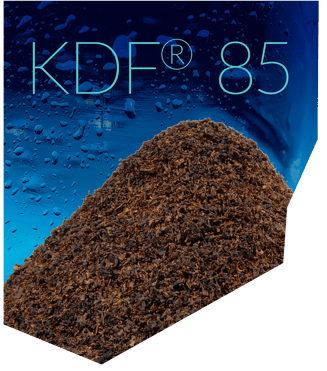
KDF® Process Media is designed with lifecycle performance in mind. Its high-purity copper-zinc formulation enables consistent electrochemical reactions that help reduce chlorine, control scale, and inhibit microbial growth — without chemicals or electricity.
Because its performance mechanism is inherently durable, KDF® Process Media maintains effectiveness over extended service life in a wide range of applications. This stability helps support reliable system operation while protecting downstream components from unnecessary wear.
That’s why water professionals continue to specify KDF® — not just for what it does at startup, but for how it performs year after year.
In modern water treatment systems, longevity shouldn’t be treated as a nice-to-have. It’s a measurable indicator of real performance.
When media are evaluated across their full lifecycle, durability becomes a differentiator. Systems last longer. Maintenance demands drop. And protection becomes something you can rely on — not just at installation, but over time.
Because protection isn’t a moment. It’s performance that holds up.

Protection You Can Pass Down Protection isn’t just about solving today’s problem. It’s about safeguarding what comes next.
Why RO Membrane Longevity Is the Missing Link in Sustainable Water Treatment